


Deepeeka Swords
-
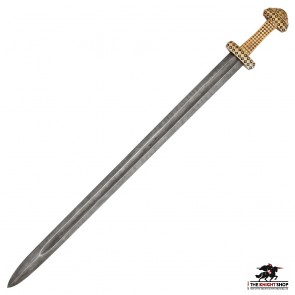

Peterson Type D Bronze Hilt Viking Sword - Damascus Steel
Based on an original in the Museum of Cultural History in Oslo, our Peterson Type D Viking Sword is typical of those wielded by Viking warriors of the 9th and 10th centuries. The ornately crafted hilt signifying that its owner was of high status. The hilt fittings have been cast in bronze and mounted using the traditional method of construction; riveting a cap over the pommel base. The grip is also cast from bronze in a similar fashion to a sword found on the Isle of Eigg in Scotland. At the base of the guard is a protective strip of felt that can be removed if required.
Learn More
The blade was formed by twisting bars of steel around each other, welding the bars together by hammering and then repeating the process to create this distinct chevron pattern. The leather-bound wooden scabbard is decorated with bronze “knotwork” fittings of Norse origin and features a suspension loop allowing it to be fastened to a belt of baldric.
Total Length: 96.2cm
Blade Length: 78.4cm
Grip Length: 10cm
Weight: 1.61kg
Blade Thickness (base): 4.4mm
Blade Thickness (CoP): 4.5mm
Blade Width (base): 4.3cm
Point of Balance (PoB): 16cm
Blade: EN45 High Carbon Steel
Edge: Blunt
Pommel: Riveted and Threaded
Scabbard: Bronze
All dimensions are approximate and may vary from piece to piece.Excl. Tax: £382.50 Incl. Tax: £459.00 -


Peterson Type D Bronze Hilt Viking Sword - Leather Grip
Based on an original in the Museum of Cultural History in Oslo, our Peterson Type D Viking Sword is typical of those wielded by Viking warriors of the 9th and 10th centuries. The ornately crafted hilt signifying that its owner was of high status. The hilt fittings have been cast in bronze and mounted using the traditional method of construction; riveting a cap over the pommel base. The hardwood grip is tightly bound in leather.
Learn More
It features a forged and tempered high carbon steel blade that is designed for hacking and slashing, such was the fighting style of the era. The leather bound wooden scabbard is decorated with bronze “knotwork” fittings of Norse origin and features a suspension loop allowing it to be fastened to a belt of baldric.
Total length: 96.2 cm
Blade length: 78.4 cm
Grip length: 10 cm
Weight: 1.47 kg
Blade thickness (base): 4.8 mm
Blade thickness (CoP): 3.7 mm
Blade width (base): 4.6 cm
Point of Balance (PoB): 16 cm
Blade: EN45 High Carbon Steel
Edge: Blunt
Pommel: Nut and Riveted
Scabbard: Leather, Wood, Bronze
All dimensions are approximate and may vary from piece to piece.Excl. Tax: £208.33 Incl. Tax: £250.00 -

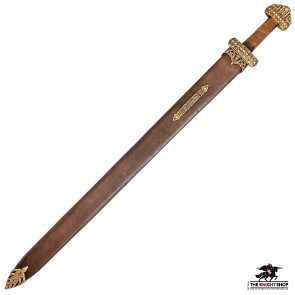
Isle of Eigg Viking Sword - Leather Grip
The hilt of the Isle of Eigg Sword is the finest example of a Viking sword hilt ever found in Scotland and currently resides on the National Museums of Scotland collection. It was discovered on the island of Eigg in the Inner Hebrides by a local farmer whilst levelling a mound. The mound is thought to have contained a pagan burial and also contained bronze bucket mounts, a whetstone and some pieces of the original blade.
Learn More
Our Isle of Eigg Sword replica features a double-edged blade with wide central fuller. The grip, guard and pommel are made of cast bronze. The unsharpened blade is made of well-tempered mild steel and is peened at the pommel for durability. It comes complete with a leather-wrapped wooden scabbard with similar bronze fittings.
Total Length: 97.5cm
Blade Length: 80cm
Blade Width: 5cm
Grip Length: 17.5cm
Weight: 2kg
Blade: EN45 High Carbon Steel
Edge: Blunt
Pommel: Peened
Scabbard: Wood, Leather, Brass
All dimensions are approximate and may vary from piece to piece.Excl. Tax: £208.33 Incl. Tax: £250.00 -

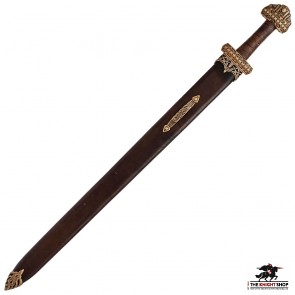
Isle of Eigg Viking Sword - Damascus Steel
The hilt of the Isle of Eigg Sword is the finest example of a Viking sword hilt ever found in Scotland and currently resides on the National Museums of Scotland collection. It was discovered on the island of Eigg in the Inner Hebrides by a local farmer whilst levelling a mound. The mound is thought to have contained a pagan burial and also contained bronze bucket mounts, a whetstone and some pieces of the original blade.
Learn More
The sword dates from around the 9th or 10th century. All parts of the hilt are richly decorated animal and geometric ornament in panels. Some of the original decoration was inlaid with silver or silver thread.
Total Length: 96.2cm
Blade Length: 78.4cm
Grip Length: 10cm
Weight: 1.5kg
Blade Thickness (base): 4.4mm
Blade Thickness (CoP): 4.5mm
Blade Width (base): 4.3cm
Point of Balance (PoB): 16cm
Blade: Damascus Steel
Edge: Blunt
Pommel: Riveted and Threaded
Scabbard: Leather, Wood, Bronze
All dimensions are approximate and may vary from piece to piece.Excl. Tax: £379.17 Incl. Tax: £455.00 -


Wooden Roman Mainz Gladius (Rudis)
PLEASE NOTE THAT NO GUARANTEE IS OFFERED WITH THIS PRODUCT. IF YOUR WASTER BREAKS NO REPLACEMENT WILL BE OFFERED AS THE MANUFACTURER WILL NOT SUPPLY US WITH A REPLACEMENT. IF YOU WANT A MORE DURABLE WASTER PLEASE PURCHASE OUR SYNTHETIC SPARRING SWORDS.
Learn More
The Roman Gladius was the primary weapon of the Roman Legionary and was used in conjunction with the 'Scutum' (shield) and 'Pilum' (spear). Its design was strongly influenced by the swords used by the Iberian (Spanish) Celts. It was predominantly designed as a thrusting weapon and was in use in one form or another from the 4th Century BC to the 3rd Century AD.
The Roman Wooden Sword is a replica based on historical research and is authentic in its design. These were typically used by Romans for combat training. This wooden sword is perfect for practising your sword-fighting skills, or when you simply can't carry steel to an event.
Overall Length: 68.5cm
Blade Length: 51cm
Blade Width: 6.9cm
Blade Thickness: 2.2cm
Weight: 272g
Material: Wood
Scabbard: None
All dimensions are approximate and may vary from piece to piece.Excl. Tax: £19.58 Incl. Tax: £23.50 -
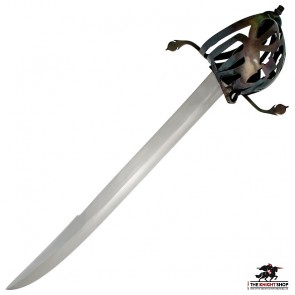

Sinclair Sabre - Scottish Cutlass
The Sinclair Sabre is a type of cutlass also known as a Dusägge (or Dusack). It was named after George Sinclair, a mercenary captain from Scotland whose men frequently carried these swords.
Learn More
In 1612 he was transported by the pirate captain Robert Stewart to fight the Danes but ambushed and killed when leading his men against Norwegian militia.
Total Length: 80cm
Blade Length: 64cm
Grip Length: 10cm
Weight: 1594g
Blade Thickness (base): 10mm
Blade Width (base): 4.5cm
Point of Balance (PoB): 7cm
Blade: High Carbon Steel
Edge: Blunt
Pommel: Nut
Scabbard: Leather, Wood, Steel
All dimensions are approximate and may vary from piece to piece.Excl. Tax: £96.67 Incl. Tax: £116.00 -

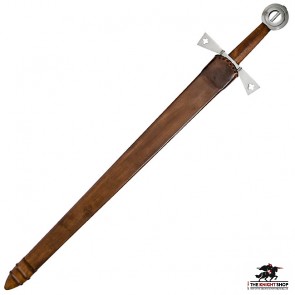
Stage Combat Gaelic Ring Hilt Sword
Our Stage Combat swords feature tempered, high carbon steel blades and are designed for light combat use. They have durable, thick edges, more than suitable for the rigours of stage combat and display fights. They also feature rounded tips for extra safety.
Learn More
Stage Combat swords are noticeably heavier than historical replicas due to the added weight afforded by the thicker edges. These swords are not designed for re-enactment use.
Overall Length: 93.5cm
Blade Length: 76cm
Blade Width: 5cm
Blade Thickness: 0.7cm
Edge Thickness: 0.2cm
Weight: 1214g
Point of Balance: 17.5cm
Material: EN45 High Carbon Steel
Edge: Blunt
Pommel: Peened
Scabbard: Leather, wood
All dimensions are approximate and may vary from piece to piece.Excl. Tax: £141.67 Incl. Tax: £170.00 -

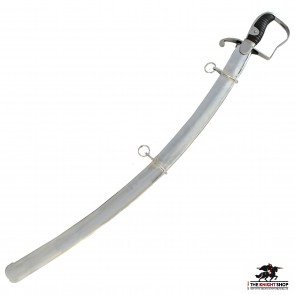
British Light Cavalry Sabre - 1796 Pattern
Light Cavalry refers to lightly armed troops whose major tasks were reconnaissance, screening, skirmishing, raiding, and communications. They used to carry a light sword like this. This Light Cavalry sword found its use mainly around 1796. It has a curved blade, which makes it easy to be carried around the waist while riding on the horse.
Learn More
Total Length: 96cm
Blade Length: 83cm
Grip Length: 9.5cm
Weight: 1.078kg
Blade Thickness (base): 6mm
Blade Width (base): 3.4cm
Point of Balance (PoB): 22cm
Blade: AISI 1065 High Carbon Steel
Edge: Blunt
Pommel: Peened
Scabbard: Steel
All dimensions are approximate and may vary from piece to piece.Excl. Tax: £81.67 Incl. Tax: £98.00 -

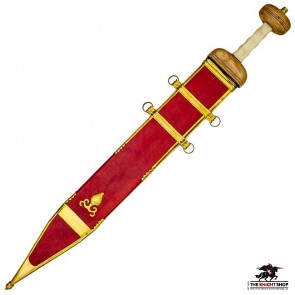
Roman Mainz Gladius
Our Roman Mainz Gladius features a turned wood pommel and bone grip. The straight blade is hand forged from steel and is housed in a wooden scabbard with red leather covering and decorated brass fittings.
Learn More
This sword is not designed or recommended for contact reenactment (fighting) but is favoured by living history enthusiasts.
Overall Length: 72cm
Blade Length: 54cm
Blade Width: 6.5cm
Blade Thickness: 0.5cm
Weight: 818g
Material: EN45 High Carbon Steel
Edge: Blunt
Pommel: Nut
Scabbard: Wood, Leather, Brass
All dimensions are approximate and may vary from piece to piece.Excl. Tax: £107.50 Incl. Tax: £129.00 -
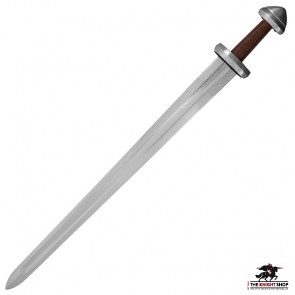

Hersir Viking Sword
Our Hersir Viking Sword is a historically accurate replica of a Viking Sword. This style of Viking era sword is referred to as a Type H hilt in Petersen's Typology and has a triangular pommel. It seems this type is typically thought to have been found extensively in Norway, but as far south as Switzerland and Yugoslavia, and that the type H seems to have been in use around the late 8th c. to into the 10th.
Learn More
The Hersir Viking Sword features a pommel and upper guard made in two parts, riveted together, with a twisted wire between the pommel and upper guard. The high carbon steel blade is housed in a leather and wood scabbard.
Total Length: 96.5cm
Blade Length: 78.5cm
Grip Length: 10.5cm
Weight: 1598g
Point of Balance: 13.5cm
Blade Thickness (base): 0.53cm
Blade Width (base): 6cm
Material: High Carbon Steel, leather
Edge: Blunt
Pommel: Peened
Scabbard: Leather, wood, steel
All dimensions are approximate and may vary from piece to piece.Excl. Tax: £104.17 Incl. Tax: £125.00
Shopping Options
- Product Use
-
- Display (43)
- Living History (32)
- Stage Combat (5)
- Price
-
- £0.00 - £19.99 (2)
- £20.00 - £39.99 (1)
- £40.00 - £59.99 (1)
- £60.00 - £79.99 (4)
- £80.00 - £99.99 (13)
- £100.00 - £119.99 (12)
- £120.00 - £139.99 (8)
- £140.00 - £159.99 (3)
- £160.00 - £179.99 (1)
- £200.00 and above (17)
- Edge
-
- Blunt (59)
- Member Discounts
- Brand
-
- Deepeeka (62)