


Deepeeka Swords
-


Stage Combat Hersir Viking Sword
Our Stage Combat swords feature tempered, high carbon steel blades and are designed for light combat use. They have durable, thick edges, more than suitable for the rigours of stage combat and display fights. They also feature rounded tips for extra safety. Stage Combat swords are noticeably heavier than historical replicas due to the added weight afforded by the thicker edges. These swords are not designed for re-enactment use.
Learn More
Our Hersir Viking Sword is a historically accurate replica of a Viking Sword. This style of Viking era sword is referred to as a Type H hilt in Petersen's Typology and has a triangular pommel. It seems this type is typically thought to have been found extensively in Norway, but as far south as Switzerland and Yugoslavia, and that the type H seems to have been in use about latter 8th c. to into the 10th.
Overall Length: 97.5cm
Blade Length: 79cm
Blade Width: 5.7cm
Blade Thickness: 0.5cm
Weight: 1672g
Point of Balance: 13cm
Material: EN45 High Carbon Steel
Edge: Blunt
Pommel: Peened
Scabbard: Leather, wood, steel
All dimensions are approximate and may vary from piece to piece.Excl. Tax: £125.00 Incl. Tax: £150.00 -
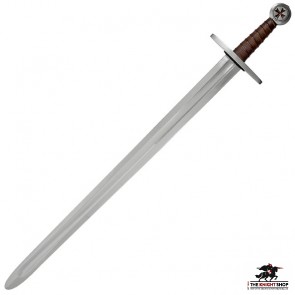

Stage Combat Knights Templar Arming Sword
Our Stage Combat swords feature tempered, high carbon steel blades and are designed for light combat use. They have durable, thick edges, more than suitable for the rigours of stage combat and display fights. They also feature rounded tips for extra safety. Stage Combat swords are noticeably heavier than historical replicas due to the added weight afforded by the thicker edges. These swords are not designed for re-enactment use.
Learn More
Our Knights Templar Arming Sword features an unsharpened carbon steel blade with central fuller. The grip is wood wrapped in brown leather and flanked with a steel guard and pommel. The pommel is emblazoned with an enamelled Templar red cross. Comes complete with wooden scabbard wrapped in brown leather with polished steel fittings.
Total Length: 95cm
Blade Length: 78cm
Grip Length: 11cm
Weight: 1328g
Point of Balance: 15cm
Guard Width: 16cm
Blade Thickness (base): 0.42cm
Blade Width (base): 4.9cm
Material: High Carbon Steel, leather
Edge: Blunt
Pommel: Peened
Scabbard: Leather, wood, steel
All dimensions are approximate and may vary from piece to piece.Excl. Tax: £125.00 Incl. Tax: £150.00 -


Knight's Templar Arming Sword
Our Knights Templar Arming Sword features an unsharpened carbon steel blade with central fuller. The grip is wood wrapped in brown leather and flanked with a steel guard and pommel. The pommel is emblazoned with an enamelled Templar red cross.
Learn More
Comes complete with wooded scabbard wrapped in brown leather with polished steel fittings. This sword has a blunt blade and is manufactured for display only.
Total Length: 94.5cm
Blade Length: 77.5cm
Grip Length: 11cm
Weight: 1046g
Blade Thickness (base): 0.44cm
Blade Width (base): 4.6cm
Blade: High Carbon Steel
Edge: Blunt
Pommel: Peened
Scabbard: Leather, Wood, Steel
All dimensions are approximate and may vary from piece to piece.Excl. Tax: £108.33 Incl. Tax: £130.00 -


Isle of Eigg Viking Sword
The hilt of the Isle of Eigg Sword is the finest example of a Viking sword hilt ever found in Scotland and currently resides on the National Museums of Scotland collection. It was discovered on the island of Eigg in the Inner Hebrides by a local farmer whilst levelling a mound. The mound is thought to have contained a pagan burial and also contained bronze bucket mounts, a whetstone and some pieces of the original blade.
Learn More
Our Isle of Eigg Sword replica features a double-edged blade with wide central fuller. The grip, guard and pommel are made of cast bronze. The unsharpened blade is made of well-tempered mild steel and is peened at the pommel for durability. It comes complete with a leather-wrapped wooden scabbard with similar bronze fittings.
Total Length: 97.5cm
Blade Length: 80cm
Blade Width: 5cm
Grip Length: 17.5cm
Weight: 2kg
Blade: EN45 High Carbon Steel
Edge: Blunt
Pommel: Peened
Scabbard: Wood, Leather, Brass
All dimensions are approximate and may vary from piece to piece.Excl. Tax: £201.67 Incl. Tax: £242.00 -

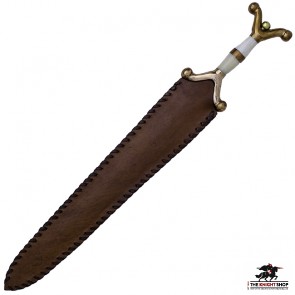
Celtic Sword
The Celtic Sword features and anthropomorphic hilt - the human form must have been intended to enhance the power of the owner and to bear a talismanic significance. The British Museum has some excellent examples of this style of sword in their collection.
Learn More
This replica is of a type associated with the La Tène culture, named after the important Celtic site on Lake Neuchâtel in present-day Switzerland and eastern France. It features a polished bronze hilt with bone grip - both associated with high status. The blade is hand forged from steel and is housed in a hand stitched leather scabbard. This item has a blunt blade and is manufactured for display only.
Total Length: 62cm
Blade Length: 46cm
Grip Length: 8cm
Weight: 1050g
Blade Thickness (base): 0.5cm
Blade Width (base): 4.7cm
Point of Balance (PoB): 6cm
Blade: EN45 High Carbon Steel
Edge: Blunt
Pommel: Nut
Scabbard: Leather
All dimensions are approximate and may vary from piece to piece.Excl. Tax: £59.17 Incl. Tax: £71.00 -


Spartan Sword with Baldric
Our Spartan Sword is inspired by those wielded by the hoplites in King Leonidas’s army when defending the Hot Gates against attack from the Persian Army.
Learn More
It features a blackened solid steel guard and leather wrapped grip. The blade is forged from steel and is designed for hacking and slashing. It comes complete with a leather scabbard and baldric strap designed to be worn over the shoulder.
This sword features a blunt blade and is designed for display only.
Overall Length: 69cm
Blade Length: 53cm
Grip length: 11cm
Weight: 1314g
Blade width (base): 3.5cm
Blade: EN45 High Carbon Steel
Edge: Blunt
Pommel: Peened
Scabbard: Leather
All dimensions are approximate and may vary from piece to piece.Excl. Tax: £87.50 Incl. Tax: £105.00 -


Horse Head Falcata (Kopis)
The Celt-Iberians of Roman times were justly famed for their weapons, such as the Falcata; one of the most devastating swords ever made! The inward curving blade delivers a tremendous blow and could split both shield and helmet. Considered to be of Greek, or possibly Etruscan origin, this sword spread into Southern Russia and also Spain. It was in Spanish hands that it was most feared by the Romans.The blade is forged from high carbon steel and is topped by a bronze horse-head hilt and real bone grip.
Learn More
Our Falcata comes complete with a wooden scabbard covered in red leather. Attached to the scabbard is a small knife with bone handle and steel blade.
Total Length: 63cm
Blade Length: 51cm
Grip Length: 8cm
Weight: 1344g
Blade Thickness (base): 0.6cm
Blade Width (base): 6.26cm
Point of Balance (PoB): 14cm
Blade: EN45 High Carbon Steel
Edge: Blunt
Pommel: Integrated
Scabbard: Leather
All dimensions are approximate and may vary from piece to piece.Excl. Tax: £91.67 Incl. Tax: £110.00 -


Roman Legionary Pompeii Gladius
Our Pompeii Gladius features a turned wood pommel and bone grip. The straight blade is hand forged from steel and housed in a wooden scabbard with red leather covering and brass fittings.
Learn More
This sword is not designed or recommended for contact reenactment (fighting) but is favoured by living history enthusiasts.
Total Length: 76cm
Blade Length: 49cm
Scabbard: Wood and Leather
All dimensions are approximate and may vary from piece to piece.Excl. Tax: £69.17 Incl. Tax: £83.00 -


Roman Pompeii Gladius - Decorated
The Roman Gladius was the primary weapon of the Roman Legionary and was used in conjunction with the 'Scutum' (shield) and 'Pilum' (spear). Its design was strongly influenced by the swords used by the Iberian (Spanish) Celts. It was predominantly designed as a thrusting weapon and was in use in one form or another from the 4th Century BC to the 3rd Century AD.
Learn More
The Pompeii Gladius takes its name from the archaeological site in Italy where, during excavations, 4 such swords were found. The swords are dated to before 79AD - the year that Pompeii was buried in volcanic ash. The Pompeii Gladius, along with the earlier Mainz Pattern Gladius, would have been issued to the garrison at Hadrian’s Wall. Examples can be seen in H. Russell Robinson’s book "What The Soldiers Wore On Hadrians Wall'".
Our Pompeii Gladius features a turned wood pommel and bone grip. The straight blade is hand forged from steel and in housed in a wooden scabbard with red leather covering and decorated brass fittings. This sword is not designed or recommended for contact reenactment (fighting) but is favoured by living history enthusiasts.
Overall Length: 70cm
Blade Length: 48cm
Width: 4.9cm
Grip Length: 10.8cm
Weight: 1135g
Thickness: 5mm
P.O.B: 11cm
Edge: Blunt
Pommel: Threaded
Scabbard: Wood, Leather, Brass
All dimensions are approximate and may vary from piece to piece.Excl. Tax: £99.17 Incl. Tax: £119.00 -


Seax of Beagnoth
On one side of the blade is the only known complete inscription of the twenty-eight letter Anglo-Saxon runic alphabet, as well as the name "Beagnoth" in runic letters. It is thought that the runic alphabet had a magical function, and that the name Beagnoth is that of either the owner of the weapon or the smith who forged it.
Learn More
Although many Anglo-Saxon and Viking swords and knives have inscriptions in the Latin alphabet on their blades, or have runic inscriptions on the hilt or scabbard, the Seax of Beagnoth is one of only a handful of finds with a runic inscription on its blade.
Total length: 73.5cm
Blade length: 55.5cm
Grip length: 18cm
Weight: 906g
Blade width (base): 4.3cm
Blade: EN45 High Carbon Steel
Edge: Blunt
Scabbard: Stitched Leather
All dimensions are approximate and may vary from piece to piece.Excl. Tax: £71.67 Incl. Tax: £86.00
Shopping Options
- Product Use
-
- Display (43)
- Living History (32)
- Stage Combat (5)
- Price
-
- £0.00 - £19.99 (2)
- £20.00 - £39.99 (1)
- £40.00 - £59.99 (1)
- £60.00 - £79.99 (4)
- £80.00 - £99.99 (13)
- £100.00 - £119.99 (12)
- £120.00 - £139.99 (8)
- £140.00 - £159.99 (3)
- £160.00 - £179.99 (1)
- £200.00 and above (17)
- Edge
-
- Blunt (59)
- Member Discounts
- Brand
-
- Deepeeka (62)