


Medieval Longswords
-
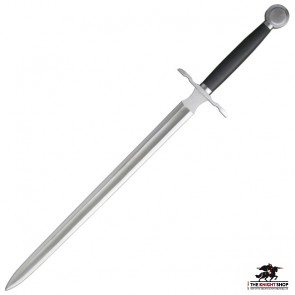

Hand-and-a-Half Sword
Paul Chen swords are crafted in much the same way as swords were made centuries ago, except now the blades are forged from high-carbon spring steel. The blade finish is far from being polished again more closely replicating what the medieval swordsmith was able to achieve. Except as noted the grips are leather covered hardwood. Fittings are either steel or solid brass. These swords will appeal to the re-enactor who wants a sword with the same appearance as the originals.
Learn More
This version of a 16th-century piece provides an economical and versatile cutting sword. Balance is excellent, providing a sword which lends itself to both single and two-handed use.
Total Length: 94.6cm
Blade Length: 69.3cm
Grip Length: 19cm
Weight: 1280g
Blade Thickness (base): 0.6cm
Blade Width (base): 4.5cm
Blade: 1566 High Carbon Steel
Edge: Sharp
Pommel: Peened
Scabbard: Wood, Leather & Steel
All dimensions are approximate and may vary from piece to piece.Excl. Tax: £258.33 Incl. Tax: £310.00 -
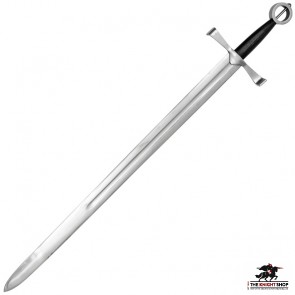
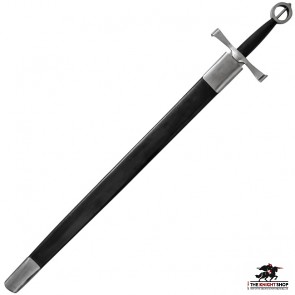
Irish Ring Hilt Sword
Our Irish Ring Hilt sword features a high carbon steel blade with central fuller, polished steel hilt fittings and a leather wrapped wood grip. It comes complete with a leather wrapped wooden scabbard with steel fittings.
Learn More
Total Length: 105cm
Blade Length: 84cm
Blade Width: 5.2cm
Blade Thickness: 0.55cm
Weight: 1686g
Point of Balance: 26.5cm
Material: EN45 High Carbon Steel
Edge: Blunt
Pommel: Threaded
Scabbard: Leather, wood
All dimensions are approximate and may vary from piece to piece.Excl. Tax: £95.83 Incl. Tax: £115.00 -


Gallowglass Sword
The word Gallowglass is an Anglicisation of the Irish word Gallóglaigh meaning “foreign soldiers”. They were mercenary warrior elite among Scottish clans living in the Highlands and Western Isles between the 13th and 16th century. During the 13th century they started to settle in Ireland where military chieftains would frequently use them as bodyguards as they were not subject to local feuds or influences.
Learn More
A description from 1600, speaks of the Gallowglass as "...pycked and scelected men of great and mightie bodies, crewell without compassion. The greatest force of the battell consisteth in them, chosing rather to dye than to yeelde, so that when yt cometh to handy blowes they are quickly slayne or win the fielde." They were famed for using their broadswords or claymores ("claíomh mór" - Gailic for “Great Sword”) with terrifying effect in battle.
Overall Length: 136cm
Blade Length: 104cm
Blade Width: 6.35cm
Blade Thickness: 0.6cm
Guard Width: 30cm
Guard Depth: 2.9cm
Grip Length: 18.5cm
Blade: High Carbon Steel
Edge: Blunt
Pommel: Peened
Scabbard: None
All dimensions are approximate and may vary from piece to piece.Excl. Tax: £125.00 Incl. Tax: £150.00 -


Two Handed Scottish Claymore
The Claymore (from the Scottish Gaelic claidheamh-mòr, meaning “great sword”) is a Scottish variant of the late medieval 2 handed sword. It differed from other longswords of the period in that it usually had forward sloping quillons terminating in quatrefoils. Claymores were in use during constant clan warfare and fights with the English from the 15th to 17th century. Claymores did exist as early as the Wars of Scottish Independence although they were smaller and few had the characteristic quatrefoil design. The last time that claymores were seen on the battlefield in any significant number was the Battle of Killiecrankie in 1689.
Learn More
Our Two Handed Scottish Claymore has a hand-forged high carbon steel blade topped with solid steel hilt fittings and a stained real wood grip. This sword has a blunt blade and is designed for display only.
Overall Length: 123cm
Blade Length: 92cm
Blade Width: 5.8cm
Blade Thickness: 0.5cm
Guard Width: 29cm
Guard Depth: 2.9cm
Grip Length: 19cm
Blade: High Carbon Steel
Edge: Blunt
Pommel: Peened
Scabbard: None
All dimensions are approximate and may vary from piece to piece.Excl. Tax: £115.00 Incl. Tax: £138.00
Shopping Options
- Product Use
-
- Display (7)
- Battle Re-enactment (2)
- Living History (11)
- Test Cutting (6)
- HEMA Sparring (1)
- Stage Combat (2)
- Price
-
- £80.00 - £99.99 (1)
- £100.00 - £119.99 (2)
- £120.00 - £139.99 (4)
- £160.00 - £179.99 (2)
- £180.00 - £199.99 (1)
- £240.00 - £259.99 (3)
- £280.00 and above (1)
- Edge
-
- Blunt (7)
- Blunt - Sharpenable (4)
- Sharp (3)
- Member Discounts
- Brand
-
- Deepeeka (4)
- Hanwei (2)
- Red Dragon Armouries (4)
- Windlass (4)