


Re-enactment
Welcome to our Re-enactment section where you will find all of our Re-enactment approved lines from dedicated Re-enactment suppliers such as GDFB and Marshal Historical. The items featured in this section are manufactured and approved for Re-enactment and Living History use, whether it be on or off the battlefield. The weaponry and armour in this section is either designed for battlefield use, with a few exceptions that can either be modified to meet the required safety standards or are working historical replicas that are designed for Living History. The clothing that is listed in this section is manufactured to historical designs and is mostly made from period appropriate fabrics such as wool or linen.
-


British Infantry Officer's Sword - 1796 Pattern
When the British Army standardized the swords to be carried by infantry officers in 1796 this is the sword they settled on; a spadroon-like cut-and-thrust sword with simple, but elegant Georgian styling that hearkened back to the Smallswords carried by gentlemen in earlier times. In just four years following, the blade was at the hip of practically all British Line Infantry Officers. Regardless of the standardization of form, the blades varied in their width and in their engraved decoration.
Learn More
Though widespread, it was not regarded as a good combat blade despite being used through the entirety of Britain’s contests with France in the Napoleonic Era. It would not be officially replaced until 1822 by the more elaborate ‘’Gothic-Hilted’’ sword and before then many officers had opted to acquire the 1803 Pattern sabre instead.
Total Length: 100cm
Blade Length: 85cm
Grip Length: 6cm
Guard width: 9.5cm
Weight: 946g
Blade Thickness (base): 0.6cm
Blade Width (base): 2.5cm
Point of Balance (PoB): 33cm
Blade: AISI 1065 High Carbon Steel
Edge: Blunt
Pommel: Nut
Scabbard: Leather, Wood, Brass
All dimensions are approximate and may vary from piece to piece.Excl. Tax: £208.33 Incl. Tax: £250.00 -

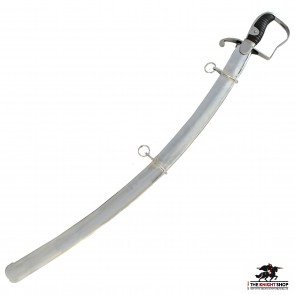
British Light Cavalry Sabre - 1796 Pattern
Light Cavalry refers to lightly armed troops whose major tasks were reconnaissance, screening, skirmishing, raiding, and communications. They used to carry a light sword like this. This Light Cavalry sword found its use mainly around 1796. It has a curved blade, which makes it easy to be carried around the waist while riding on the horse.
Learn More
Total Length: 96cm
Blade Length: 83cm
Grip Length: 9.5cm
Weight: 1.078kg
Blade Thickness (base): 6mm
Blade Width (base): 3.4cm
Point of Balance (PoB): 22cm
Blade: AISI 1065 High Carbon Steel
Edge: Blunt
Pommel: Peened
Scabbard: Steel
All dimensions are approximate and may vary from piece to piece.Excl. Tax: £81.67 Incl. Tax: £98.00 -


British Sergeant Sword - 1796 Pattern
This recreation of the British 1796 Sergeant’s sword has a plain blade of unsharpened, tempered, high carbon steel. The hilt is entirely of brass. The scabbard is of leather with brass accents.
Learn More
The sword is the longer version used by the sergeants instead of the shorter blade used by the musicians, though the overall sword design and construction were inherently the same.
Total Length: 95cm
Blade Length: 80cm
Grip Length: 9cm
Weight: 882g
Blade Thickness (base): 0.6cm
Blade Width (base): 2.5cm
Point of Balance (PoB): 32cm
Blade: AISI 1065 High Carbon Steel
Edge: Blunt
Pommel: Nut
Scabbard: Leather, Wood, Brass
All dimensions are approximate and may vary from piece to piece.Excl. Tax: £187.50 Incl. Tax: £225.00 -
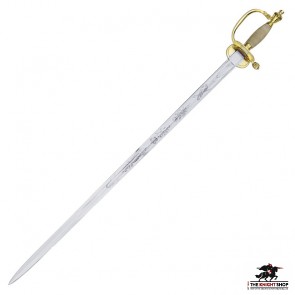

British Infantry Officer's Sword - 1796 Pattern
This replica of the 1796 British Infantry Officer sword has a blade of unsharpened, tempered high carbon steel. Both sides of the blade feature the embossed cyper of the British Crown surmounted extensively by royal devices and floral motifs.
Learn More
It has a hilt of brass and a grip wrapped in copper wire that is plated with silver. Half of the guard is hinged and folds for ease of carry at the hip. The scabbard is of leather with brass accents.
Total Length: 95cm
Blade Length: 80cm
Grip Length: 6.5cm
Weight: 784g
Blade Thickness (base): 0.7cm
Blade Width (base): 2.5cm
Point of Balance (PoB): 31cm
Blade: AISI 1065 High Carbon Steel
Edge: Blunt
Pommel: Nut
Scabbard: Leather, Wood, Brass
All dimensions are approximate and may vary from piece to piece.Excl. Tax: £187.50 Incl. Tax: £225.00 -


British Royal Navy Officer's Sword - 1805 Pattern
Up until 1805 the Royal Navy did not have a regulation pattern sword. The sword that was introduced was modelled on the 1803 pattern infantry sabre that was previously carried by Navy and Marine officers. The 1805 pattern sword was used by Lord Horatio Nelson and he was no doubt armed with it at his most famous battle, The Battle of Trafalgar.
Learn More
After he was killed at the battle his sword was returned to England and is now on display in the Nelson Museum, Great Yarmouth, England. This sword was in constant use until it was replaced in 1827 by a newer model.
The polished blade has been forged from AISI 1065 High Carbon Steel and has been well tempered.
Total Length: 95cm
Blade Length: 83cm
Grip Length: 10cm
Weight: 905g
Blade Thickness (base): 7.8mm
Blade Thickness (CoP): 5.3mm
Blade Width (base): 2.6cm
Blade Width (CoP): 2.2cm
Point of Balance (PoB): 18cm
Centre of Percussion (CoP): 25cm
Blade: AISI 1065 High Carbon Steel
Edge: Blunt
Pommel: Peened
Scabbard: Leather, Wood, Brass
All dimensions are approximate and may vary from piece to piece.Excl. Tax: £212.50 Incl. Tax: £255.00 -


Prince of Wales’s 30th Light Dragoons Officer's Sabre
Our British Light Dragoons Sabre is a replica of the swords carried by the Prince of Wales’s 30th Light Dragoon Regiments from 1794-1796. A similar sword was carried by the Princes of Wales’s 10th Light Dragoon Regiments (still in existence as the 10th Royal Hussars). The 30th Light Dragoons Regiment only existed for a couple of years, making this sword both rare and collectable. The National Army Museum in London has one of the few surviving originals in its collection.
Learn More
Total Length: 100cm
Blade Length: 86cm
Handle Length: 10cm
Blade Thickness: 7mm - 3.7mm
Point of Balance (POB): 15cm
Weight: 1kg
Blade: AISI 1065 High Carbon Steel
Edge: Blunt
Pommel: Integrated
Scabbard: Leather, Wood, Steel
All dimensions are approximate and may vary from piece to piece.Excl. Tax: £233.33 Incl. Tax: £280.00 -

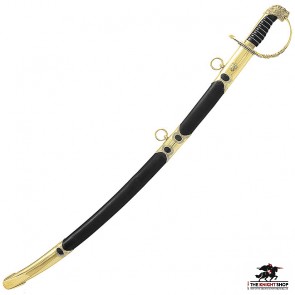
British Flank Infantry Officer's Sabre - 1803 Pattern
This sabre was introduced in 1803 and proved a popular replacement for the 1796 Infantry Sword. It was readily adopted by Light Infantry and Rifle Officers who were much more likely to skirmish with the enemy than their Line Infantry counterparts. The design proved popular and it was adopted by flank companies of the Royal Marines and some Royal Navy officers as well.
Learn More
The polished blade has been forged from AISI 1065 High Carbon Steel and has been well tempered.
Total Length: 94.5cm
Blade Length: 82cm
Grip Length: 8cm
Weight: 1.102kg
Blade Thickness (base): 7.5mm
Blade Width (base): 3cm
Point of Balance (PoB): 20cm
Blade: AISI 1065 High Carbon Steel
Edge: Blunt
Pommel: Peened
Scabbard: Leather, Wood, Brass
All dimensions are approximate and may vary from piece to piece.Excl. Tax: £187.50 Incl. Tax: £225.00 -
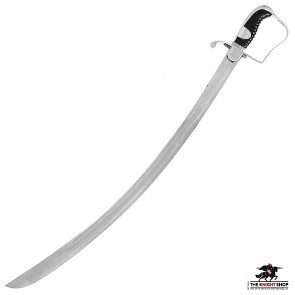

British Light Cavalry Sabre - 1796 Pattern
Famed for its use by Britain’s Light Dragoons and Hussars during the Peninsular War and Waterloo, this sword was also supplied to the Prussian Cavalry in great numbers and even found favour in the USA.
Learn More
This design was suggested for British service by cavalry officer John Gaspard Le Marchant, who believed cavalry swords should be light and have a curved, slashing blade. The long curved blade has been forged from AISI 1065 High Carbon Steel and has been well tempered.
Replacement scabbard available separately
Total Length: 96cm
Blade Length: 83cm
Grip Length: 9.5cm
Weight: 1.078kg
Blade Thickness (base): 6mm
Blade Width (base): 3.4cm
Point of Balance (PoB): 22cm
Blade: AISI 1065 High Carbon Steel
Edge: Blunt
Pommel: Peened
Scabbard: Steel
All dimensions are approximate and may vary from piece to piece.Excl. Tax: £208.33 Incl. Tax: £250.00 -
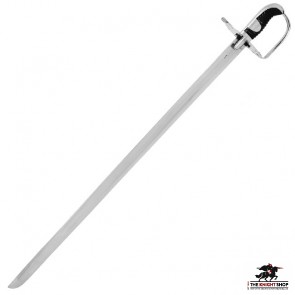
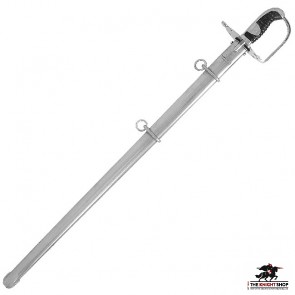
British Heavy Cavalry Sword - 1796 Pattern
The 1796 Heavy Cavalry Sword was based on the Austrian 1775 pattern sword and was used by British Heavy Cavalry regiments such as the Dragoon Guards. The large blade had incredible cutting power but was cumbersome to use. It is perhaps most famous as the sword used by Richard Sharpe of the 95th Rifles in the series of books written by Bernard Cornwell.
Learn More
The polished blade has been forged from AISI 1065 High Carbon Steel and has been well tempered.
Replacement scabbard available separately
Total Length: 102cm
Blade Length: 89cm
Grip Length: 9.5cm
Weight: 1.266kg
Blade Thickness (base): 7.3mm
Blade Thickness (CoP): 5mm
Blade Width (base): 3.4cm
Blade Width (CoP): 3cm
Point of Balance (PoB): 20cm
Centre of Percussion (CoP): 21cm
Blade: AISI 1065 High Carbon Steel
Edge: Blunt
Pommel: Peened
Scabbard: Steel
All dimensions are approximate and may vary from piece to piece.Excl. Tax: £183.33 Incl. Tax: £220.00 -


British Royal Navy Boarding Cutlass - 1804 Pattern
This pattern of sword was introduced during the Napoleonic Wars and saw service at the famous Battle of Trafalgar. Previous cutlasses shared a similar figure 8 hilt design but featured horn or leather grips that deteriorated quickly when exposed to seawater and changes in temperature.
Learn More
The introduction of an iron grip greatly extended the serviceable life of this sword. The hilts were traditionally painted or japanned to stop them from rusting. The blade has been forged from AISI 1065 High Carbon Steel and has been well-tempered. It is housed in a black hardened buff leather scabbard.
Total Length: 89cm
Blade Length: 74.5cm
Grip Length: 12cm
Weight: 1.458kg
Blade Thickness (base): 6.3mm
Blade Width (base): 3.6cm
Point of Balance (PoB): 15cm
Blade: AISI 1065 High Carbon Steel
Edge: Blunt
Pommel: Threaded
Scabbard: Leather, Brass
All dimensions are approximate and may vary from piece to piece.Excl. Tax: £135.00 Incl. Tax: £162.00
Currently Shopping by:
- Member Discounts: Military Discount Remove This Item
Shopping Options
- Product Use
-
- Display (2)
- Living History (20)
- Price
-
- £40.00 - £59.99 (4)
- £80.00 - £99.99 (1)
- £120.00 - £139.99 (1)
- £160.00 - £179.99 (1)
- £180.00 - £199.99 (6)
- £200.00 - £219.99 (10)
- £220.00 and above (1)
- Edge
-
- Blunt (24)
- Brand
-
- Deepeeka (1)
- Universal Swords (23)